Ball, then body, then space. Most players start by reading the court, and the court is the one that should come last. Get the order wrong and every decision after it arrives late, which is what losing to a slower player actually feels like.
A visual decision system for recreational doubles, levels 2.5 to 3.5.
3 reads · 3 commands · 21 lessons, each ending in a number you count
What do you do?
That read took you a few seconds. In a rally you get about one, and the whole system exists to make it automatic.
Get the system · $49The problem
You can watch professional pickleball for a hundred hours and still panic at the kitchen line. Not because you were not paying attention. It is because a highlight shows you what somebody did, and the part you needed was the read that came half a second before it.
That is the loop. More footage, more tips, more options, and no improvement in the one second where it matters. Two players with identical strokes get opposite results, because one of them decides after the ball arrives and the other decides before.
So this does the opposite of adding. Three reads, always in the same order, and only three things you are ever allowed to do with the answer. The order is not decoration. It is the part that makes it fast enough to use. Most instruction starts with the court. Here the court is the third read.
The aim: the game starts to feel slower. Not because your feet got faster, but because you stop re-deciding the same question every rally.
Same rally, twice
The difference is not how many shots you own. It is whether the options arrive all at once or in an order that throws most of them away before you have to think about them.
How the decision arrives now
Drive, dink, drop, speed up, lob, reset, or the one you have not thought of yet. All available, all at once, in about a second. So you pick the one that feels open, and feel is what changes when the score is 9 to 9.
How the cycle resolves it
Height decides what is possible. Balance decides what is safe. Only then does the court choose the target. Each read removes options the next one never has to consider, which is why it finishes in time to be useful.
The method
The order is not a style preference. Each read removes options the next one no longer has to consider, which is why it resolves fast enough to use.
Height at contact. Below the top of the net a downward ball does not exist, for you or for a professional. Physics, not judgement.
Feet set, or still moving. Balance can only ever take options away from you. It never adds one.
Which of the four players can least afford this ball. That decides the target, and where you stand next.
What a page looks like
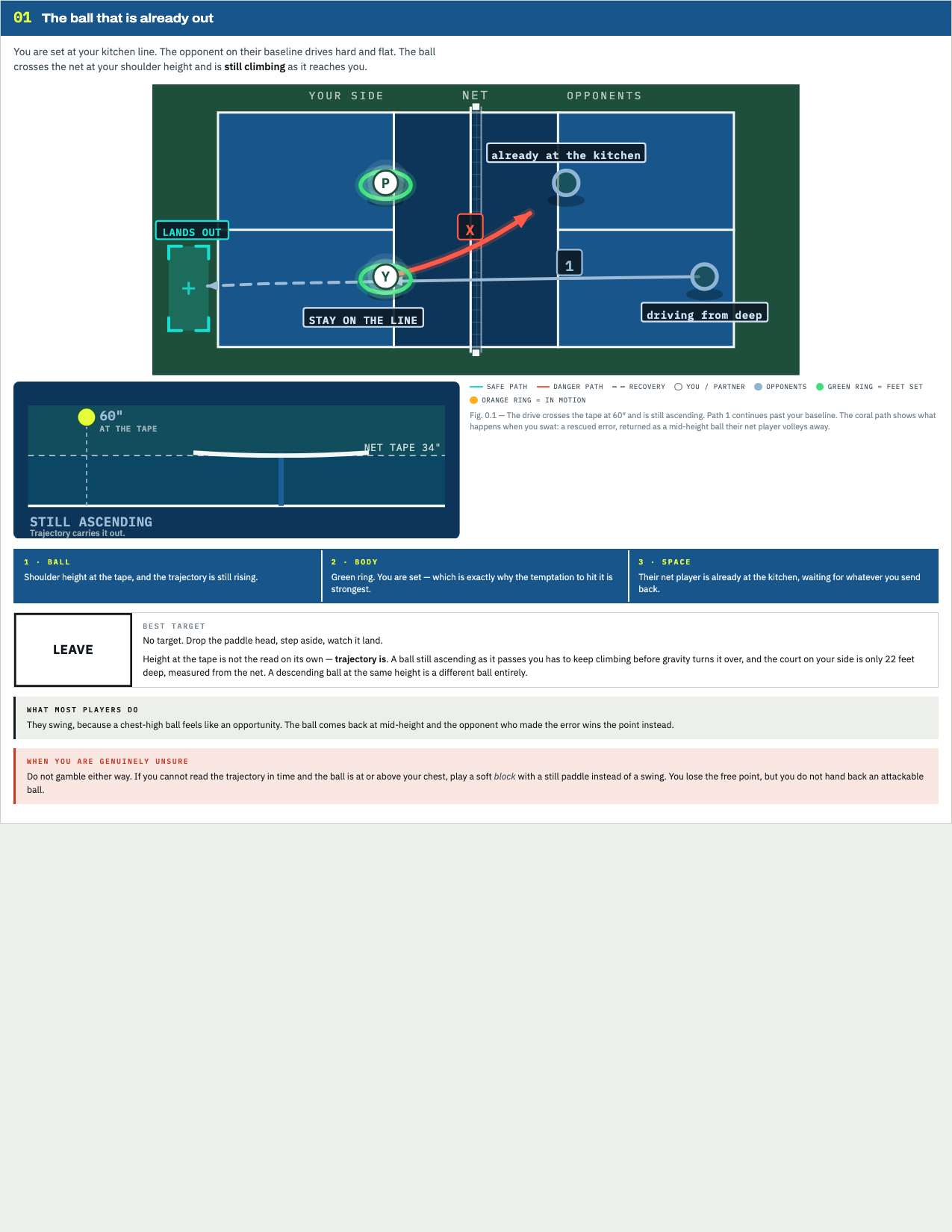
A court seen from above cannot show you how high the ball was, which is the first thing you need to know. So every scenario is paired with a side view of the net.
Lesson 2.1: the return that buys you the kitchen. Four players, the ball’s origin, the tempting mistake in coral, the higher-percentage play in teal, the landing zone, and where you recover to.
Contact at 22 inches. Below the tape, every option travels upward.
Contact at 40 inches. Above the tape, a downward angle exists for the first time in the rally.
Both ways
One PDF, set for US Letter and A4. The four tools are fillable: type into them and save, or print them and take a pen to them courtside.

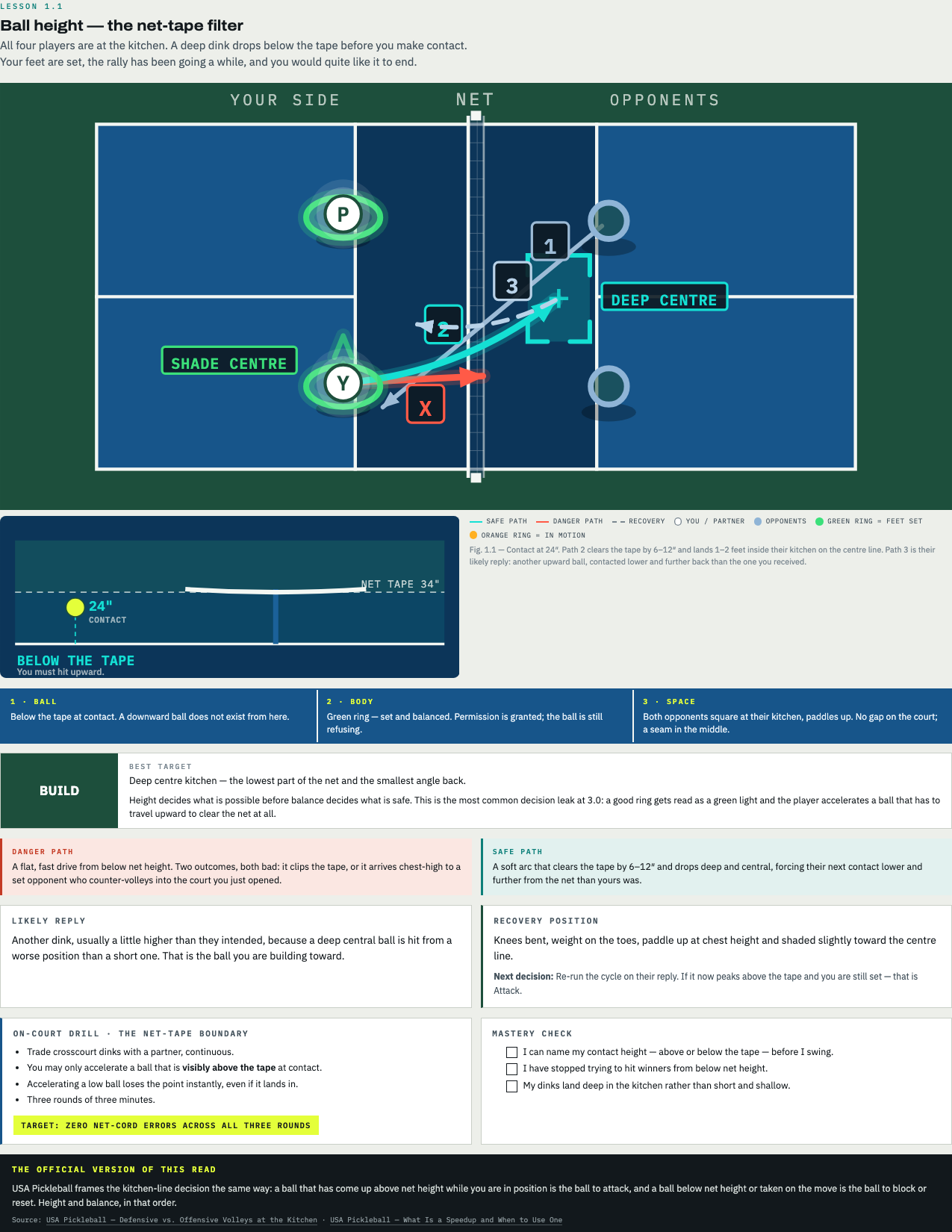
Lesson 1.2, exactly as it ships. Nothing is cropped for the screenshot: the page is built at the size you read it.
The same file on paper. The light background is deliberate: these are pages you are meant to write on, and dark pages cost you a cartridge.
What you get
Everything listed here downloads the moment you buy. No drip and no waiting.


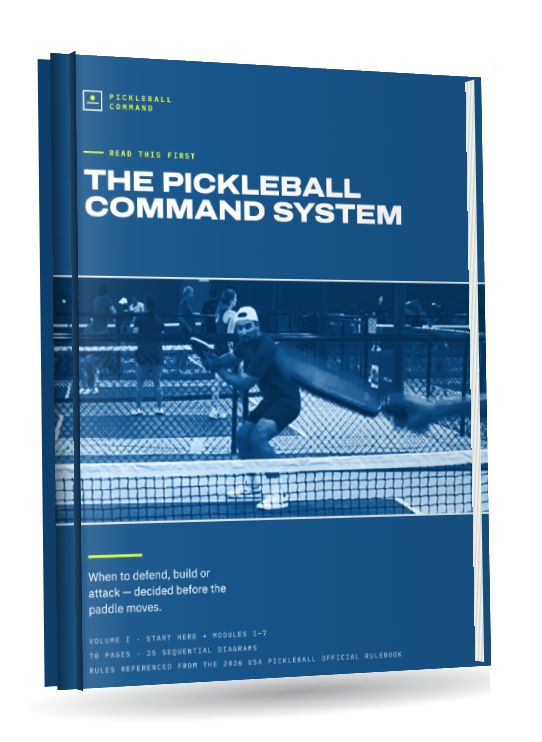
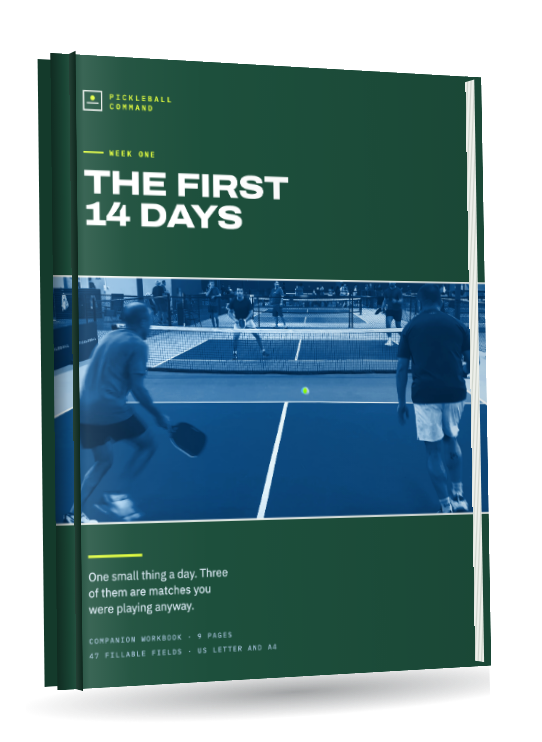
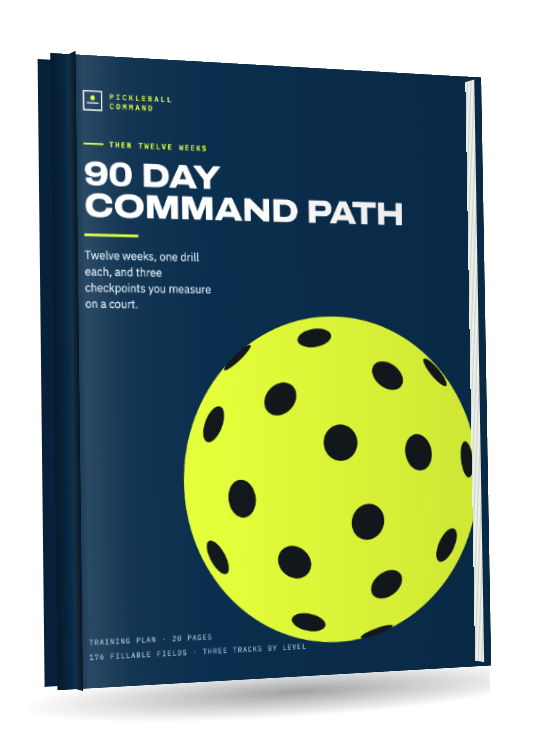
The covers are set by the same code that sets the book. What you see here is the file.
The system
Seven modules, twenty-one lessons, 70 pages. Every lesson uses the same eight blocks in the same order, so the shape of the page becomes the shape of the decision.
Part of the system · 9 pages · fillable
One small thing a day. Most take fifteen minutes; three of them are matches you were playing anyway. Day 2 is the first rule you take into a match.
Part of the system · 20 pages · fillable
A baseline you measure on a court, twelve weeks with one drill each, and three checkpoints with numbers rather than feelings.
Bonus 1 · 5 pages · fillable
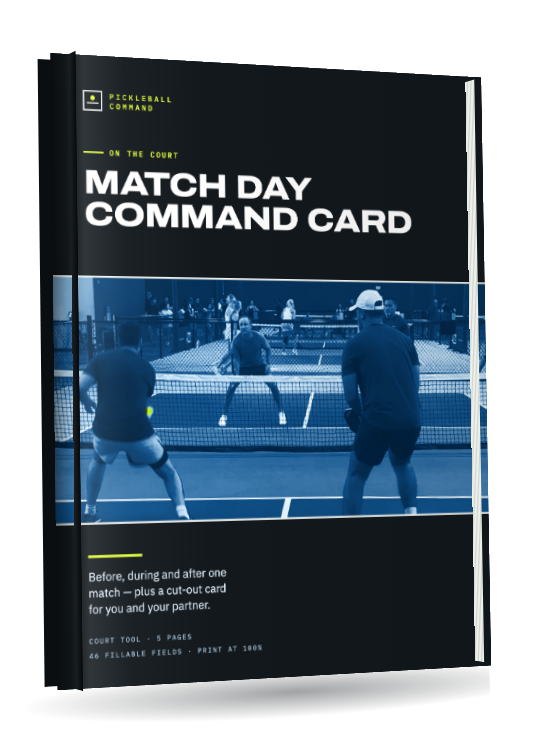
Before, during and after one match, plus a cut-out card at exactly credit-card size, in two sets. One for you, one for your partner.
Bonus 2 · 6 pages · fillable
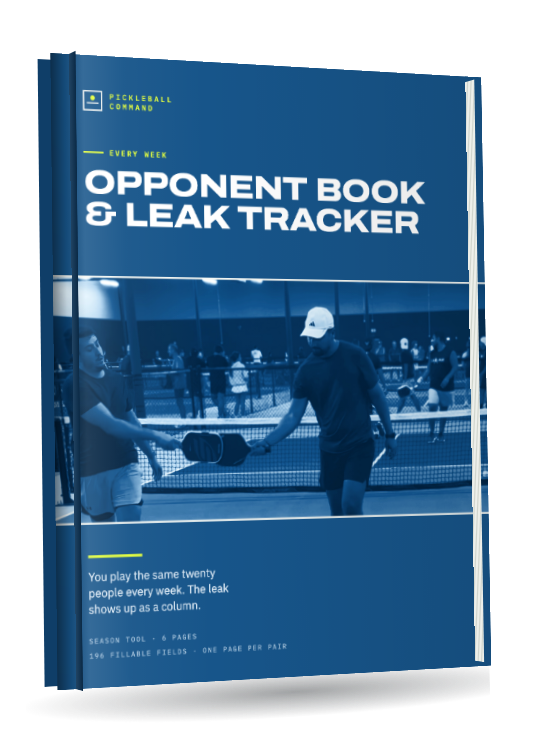
You play the same twenty people every week. One page per pair, ten matches on one grid, and the leak that keeps showing up as a column.
The commitment
Not “study the system”. Seven specific things, in order. Most take about fifteen minutes, and two of them are matches you were going to play anyway.
Read the opening. Four rallies with the decision already revealed. You are not filling anything in and you are not being tested.
One rule: you are not allowed to strike the ball while your feet are moving. Nothing else changes. It is the smallest change in the system, and the one the rest of it builds on.
Print the Match Day Command Card at actual size and cut out both pocket cards. One goes in your bag, the other goes to the partner you play with most.
The net-tape drill. You may only accelerate a ball visibly above the top of the net. Count the ones you got wrong.
Module 1, Read the Rally. Look at each diagram and decide before you read the answer, then check whether the ball or your balance should have changed your mind.
The middle. Then one message to your regular partner agreeing who takes it.
Play normally and count three things. Those three numbers are the first honest picture you have had of your own game.
There are seven more days after that, and then a ninety-day plan that starts with four numbers you measure on a court. If it turns out not to be for you, the 30-day money-back guarantee is there, no questions asked.
The difference
Not a criticism of coaches. A lesson is the fastest way to fix a stroke. This is about the material you consume between lessons.
| Most of what you have read and watched | What this does instead |
|---|---|
| Starts with the court: where to stand, where to aim | Starts with the ball. The court is the third read, not the first. It only chooses between the options the first two left you |
| Shows you what a professional did | Shows you the read that came before it: ball height, balance, and who could least afford it |
| Adds options to your game | Removes them. Three reads in a fixed order, and three things you may do with the answer |
| Tells you to be patient | Tells you which ball to attack, and what makes the difference |
| Measures progress by how you felt | Measures it by counts you write down: attempts, hits, and the split between wrong choice and poor execution |
| Sells you a transformation | Sells you a decision, repeated, and a way to check whether it is happening |
Honestly
Where this comes from
There are no testimonials on this page, because the product is new and we are not going to invent any. This is the first edition, and it has not yet been through a season of play with a group of readers. What it has been through is the rulebook, line by line.
Every rule statement in the system is traceable to it.
Eight pages cited across the modules: resets, speed-ups, volleys, positioning, returns.
6,839 shots coded across eight PPA Tour doubles matches. Rally length and shot distribution.
1,145 points coded. Source for the unforced-error figure. It is singles, not doubles, which is labelled everywhere it appears.
Our commitments
These are also printed on the back cover of the book itself.
Every number here carries a citation you can open. If we could not source it, we cut it, including a figure the competing product quotes that we could not find anywhere.
Nobody can honestly sell you a DUPR number or a win rate.
Rules are boxed and cited. Everything else is an argument you are free to disagree with on the court.
One-time payment
Lifetime access · no subscription
Get the system · $49Instant download · PDF on any device · keep it forever
30-day money-back guarantee
If it is not for you, email support@pickleballcommandsystem.com or request a refund through Hotmart within 30 days of purchase and you get your money back. No questions asked. Refund policy.
Questions
It is written for recreational doubles players roughly between 2.5 and 3.5: people who can keep a rally going and lose points they cannot explain. If you are still learning to serve consistently, take a lesson first and come back. This will still be here.
For the reading, no. For about half the drills, yes: someone to feed balls and count out loud. Several of the weekly sessions are matches you were going to play anyway, with one constraint applied.
No. It is a 70-page visual system, two workbooks and two printable tools, all as PDFs. There is no video, and the page would say so even if that were a disadvantage.
Highlights show you what a professional did. They do not show you the read that came before it, which is the part you can actually copy. Every scenario here shows the ball height, the balance, the target and the recovery, and the tempting mistake next to it.
Nobody can honestly promise that, and this page will not. What is on offer is a cleaner decision, repeated, and a way to measure whether it is happening.
Everything listed on this page, immediately after purchase, as downloadable PDFs in your Hotmart account. No drip and no waiting. You may be offered optional add-ons at checkout; they are separate purchases, and the system is complete without them.